Emiliano Manriquez
Arizona State University
September 17, 2025
What is Wastewater surveillance?
Wastewater surveillance is an innovative tool in public health that involves analyzing wastewater to monitor the presence of pathogens, chemicals, and genetic material in a population. This approach gained widespread recognition during the COVID-19 pandemic (2019–2022) when it became a key method for tracking SARS-CoV-2 shedding in human waste. By detecting viral particles from both symptomatic and asymptomatic individuals, wastewater surveillance allows public health authorities to monitor disease trends and respond quickly to emerging outbreaks.
Beyond COVID-19, wastewater surveillance has been used to detect a range of pathogens, including influenza viruses, human papillomavirus (HPV), and more recently, Mpox. This method can also track the presence of illicit drugs in communities, providing insights into public health challenges such as substance use disorders. For instance, research has highlighted the unique challenges faced by American Indian and Alaska Native (AIAN) communities in wastewater monitoring. These communities have a lower life expectancy, 5.5 years below the national average, and higher rates of lifetime substance use has occurred1. Even so, the time is now that wastewater surveillance is used to survey the general public on substance use, many examples have been published in recent years regarding these issues particularly seen in China and US, which has surveyed drug biomarkers relating to both prescription and illicit drugs2, 1, 3. Such disparities underscore the need for equitable and culturally sensitive approaches to public health surveillance to prevent misrepresentation of data.
How does it work?
Wastewater-based epidemiology (WBE) operates by collecting and analyzing samples from wastewater systems to assess viral, bacterial, or chemical markers that indicate population-level trends. This process typically involves sampling from various points in a community’s wastewater infrastructure, such as sewer systems, treatment plants, or lagoons.
Once collected, the samples are transported to specialized laboratories for analysis. Common techniques used in WBE include:
- Polymerase Chain Reaction (PCR)4: A method that amplifies small amounts of DNA or RNA to detectable levels, making it possible to identify the presence of specific pathogens like SARS-CoV-2.
- Quantitative PCR (qPCR) 5: A variation of PCR that estimates the concentration of genetic material in a sample in real time for absolute or relative quantification.
- Mass Spectrometry 6: A technique used to identify and quantify chemical compounds via the ionization of molecules, such as drug metabolites like benzoylecgonine (a byproduct of cocaine).
By integrating these methods, WBE provides a powerful snapshot of community health, enabling public health officials to track disease outbreaks, monitor illicit drug trends, and assess environmental contaminants. However, the indirect and aggregate nature of the data also presents challenges, including limitations in pinpointing exact sources of contamination and ensuring ethical use of sensitive information.
Historical Context of Wastewater Epidemiology
The roots of wastewater-based epidemiology (WBE) can be traced back to early public health efforts aimed at controlling waterborne diseases. Understanding this historical development provides valuable insight into how WBE has evolved into a modern tool for population-level surveillance. Historically, one of the earliest examples of wastewater surveillance was the monitoring of poliovirus in urban sewage systems in major cities like New York and Chicago6. This research, though limited by the technology of the time, helped establish the importance of monitoring waterborne diseases and led to public health measures such as mass vaccination campaigns and improvements in drinking water safety. Wastewater drug tracking emerged in the early 2000s, notably through research in Italy, where scientists used mass spectrometry to detect cocaine and its primary metabolite, benzoylecgonine, in rivers and wastewater treatment plants8. These pioneering studies laid the foundation for modern wastewater-based epidemiology, demonstrating its potential as a tool for monitoring both infectious diseases and chemical contaminants in communities. Significant growth in WBE research has occurred over the past decade, as shown by the increasing number of publications in PubMedFigure 1. In 2011, there were only 61 articles on wastewater epidemiology, but this number surged to 627 by 2023, reflecting heightened interest during the COVID-19 pandemic. The pandemic acted as a catalyst for innovation in the field, with WBE being used to track not only SARS-CoV-2 but also other viruses such as Influenza H3N2, H5N1, and Mpox.
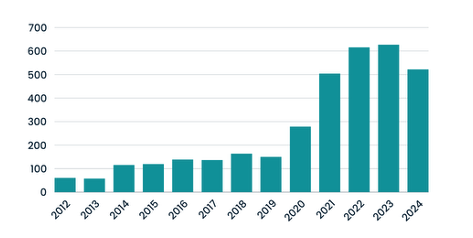
Figure 1: Number of wastewater epidemiology publications from 2011 to 2024, indicating a sharp rise during the COVID-19 pandemic.
Consent/Data Sharing within WBE
Wastewater-based epidemiology primarily uses an opt-out consent model, as it is far more difficult to obtain individual consent when sampling large and often shared wastewater systems. In an opt-in model, individuals are not included by default and must actively provide consent before their biological material or data can be used, whereas in an opt-out model, individuals are automatically included unless they explicitly refuse. It is also important to distinguish between WBE used for public health purposes and WBE used for research purposes. Opt-out consent may be justified when surveillance informs urgent public health policy decisions, such as tracking outbreaks (e.g. Covid-19, influenza, etc), but is less appropriate when the goal is research, where findings have the potential to be generalized and potentially shared beyond the immediate community. This distinction matters because the ethical threshold for informed consent is typically higher in research contexts. As described by Nainani9, this method poses ethical concerns, as people’s genetic data and potential health conditions are captured without direct consent, raising issues related to privacy and data sovereignty9. The lack of opt-in consent models within most WBE operations and research can lead to communities, more specifically Indigenous or marginalized groups, implying that their autonomy and control over their genetic data are compromised. This can and has undermined the trust these communities give to researchers, as these populations often have historical concerns with the usage of their data and exploitation that can arise from it10. Furthermore, the way researchers and agencies alert communities can differ, with AIAN communities often requiring a review process11, while other communities aren’t alerted until after data is published (e.g. CDC Wastewater Tracker), thus causing a problematic relationship between individuals and those sampling these wastewater facilities. To address these concerns, researchers and government agencies must implement transparent data practices, engage directly with affected communities, and establish strict governance frameworks. This includes clearly communicating how data is collected, analyzed, and shared while also ensuring that findings are not used to stigmatize or discriminate against specific populations, such as AIAN or racial minority communities. Though the opt-out model is suited best for WBE, principles like informed consent and individual privacy, which are major cornerstones within general biomedical ethics, are rather challenging to implement in the context of wastewater surveillance because the data collected is collected in mass and not individualized. As a result, there is little guidance on how to protect community privacy or how to ensure that findings do not inadvertently stigmatize specific groups, but that does not mean consideration of ethical principles should not be instilled. Applying foundational ethical principles from the Belmont Report (1979) can help guide WBE practices:
- Respect for Persons: Although WBE data is collective, individuals should be treated as autonomous agents, therefore creating a need for careful handling of data.
- Beneficence: Researchers must aim to maximize benefits and minimize harm, especially by safeguarding sensitive health information from marginalized communities.
- Justice: The benefits and burdens of research must be distributed fairly. Deploying WBE primarily in low-income or minority areas risks reinforcing health inequities and systemic bias.
Applying these principles to WBE highlights the need for greater transparency, community engagement, and governance. Ethical surveillance must include not just technical accuracy but also cultural sensitivity and equity.
Challenges in Data Interpretation and Bias
One significant challenge in wastewater surveillance is the difficulty in linking findings to specific geographic locations or populations. Because wastewater is often collected from large catchment areas, such as treatment plants or lagoons, it is rarely possible to pinpoint the exact source of contaminants. As Castleden12 notes, this limitation can lead to misinterpretation of data, where patterns in drug use, for example, are incorrectly attributed to particular communities. This issue becomes especially problematic when data is reported without sufficient context, as it can reinforce harmful stereotypes. For instance, if higher levels of illicit drugs or pathogens are detected in wastewater samples from areas with large populations of racial or ethnic minorities, there is a risk of stigmatizing these communities. Such findings, when misunderstood or misrepresented, can fuel discriminatory public health policies, such as increased policing or reduced investment in health and social services13. Moreover, the interpretation of wastewater data can vary across urban and rural settings. In urban areas, where populations are often more diverse, surveillance findings could be misused to justify increased policing or social control measures in historically marginalized neighborhoods, further entrenching existing inequalities14. In contrast, rural areas with smaller, more homogenous populations may face underrepresentation in surveillance data, leading to gaps in public health response. Ultimately, these challenges highlight the importance of ethical data interpretation and transparent reporting. Wastewater surveillance must avoid drawing unjustified conclusions that could harm vulnerable populations. Instead, it should be implemented with cultural sensitivity, community involvement, and a commitment to reducing; not exacerbating health disparities.
Ethical Principles in Wastewater Surveillance
Ethical principles in the field of wastewater surveillance remain underdeveloped compared to its more established counterpart, epidemiology. While guidelines for ethical research practices exist, they are often vague, inconsistently applied, and lack enforcement. This gap leaves room for the misuse or misinterpretation of data, which is especially concerning when surveillance findings are released without proper context or consideration of potential harm15. For example, if genomic data from wastewater samples is made public without sufficient explanation, it could lead to harmful conclusions or discriminatory actions against certain communities. Unlike traditional epidemiological studies, which often involve direct engagement with participants and established ethical protocols, wastewater surveillance operates most efficiently with the Opt-out model, therefore making it more challenging to address the unique ethical issues it presents as addressed previously. Therefore, the lack of a robust ethical framework will lead to significant ethical setbacks14 such as:
- Data misuse: WBE findings could be used to justify punitive measures, such as increased policing in areas with higher detected drug levels.
- Community harm: Findings might unintentionally stigmatize specific populations, especially in racially and ethnically diverse urban areas.
- Racial bias: Wastewater data interpretation can differ across settings, potentially reinforcing systemic inequalities if not handled with care.
These are all previously mentioned issues. But, to mitigate these risks, there is a pressing need for clear ethical standards tailored to WBE. These standards should emphasize:
- Transparency: Researchers must communicate how data is collected, analyzed, and shared.
- Community involvement: Populations under surveillance should have a voice in how data is used and interpreted.
- Data protection: Safeguards are essential to prevent the misuse of sensitive information, especially genomic data.
Future implications
As it currently stands, wastewater surveillance primarily focuses on public health indicators such as viral loads of pathogens like SARS-CoV-2 and, more recently, Mpox, as well as the prevalence of illicit drug use and the presence of environmental contaminants. However, as biomedical research continues to evolve, the scope of wastewater-based epidemiology (WBE) is likely to expand. Emerging areas of interest include the detection of antibiotic resistance genes within bacterial populations16 and the monitoring of genetic mutations or variations in human genomes and HPV17. These applications could provide valuable insights into the spread of antimicrobial resistance, the development of new disease variants, and broader trends in public health. However, such advancements will also raise new ethical challenges, including concerns over genetic privacy, data ownership, and the potential for misuse of sensitive information. Additionally, WBE holds promise for applications beyond traditional public health. For instance, recent studies have demonstrated its utility in monitoring climate change impacts on microbial communities in wastewater, particularly those that could harm human health or contribute to the development of antibiotic resistance. As climate change continues to alter environmental conditions, wastewater surveillance could become a critical tool for tracking the emergence and spread of pathogens influenced by shifting ecosystems18. Looking ahead, the continued advancement of WBE will require not only technical innovation but also a vigorous ethical framework that prioritizes transparency, community engagement, and data governance. Equally important is the need for policy development to regulate the collection, interpretation, and use of wastewater data, ensuring that this powerful tool serves the public good without reinforcing existing inequities.
Conclusion
In essence, wastewater-based epidemiology (WBE) stands at the forefront of public health innovation, offering a powerful tool for monitoring infectious diseases, tracking illicit drug use, and assessing environmental risks at the community level. Its applications have grown significantly in recent years, particularly in response to the COVID-19 pandemic, highlighting the potential of WBE to inform public health policies and interventions. However, as this field continues to evolve, it is crucial to address the ethical challenges that arise, especially concerning privacy, consent, data governance, and the risk of reinforcing social inequities. Without careful attention to these issues, the benefits of wastewater surveillance may come at the cost of community trust and individual rights. Looking ahead, WBE holds great potential for addressing future public health threats, from antimicrobial resistance to the effects of climate change on microbial ecosystems. Yet realizing this potential requires a commitment to transparent practices, community engagement, and the development of clear, enforceable ethical guidelines. By balancing scientific innovation with ethical responsibility, WBE can become not only a tool for public health surveillance but also a model for equitable, community-centered research that respects the rights and dignity of all populations.
Resources:
- Driver, E. M., Bowes, D. A., Halden, R. U., & Conroy-Ben, O. (2022). Implementing wastewater monitoring on American Indian reservations to assess community health indicators. Science of The Total Environment, 823, 153882.
- Wang, W., Wang, D., Liu, L., Qiu, C., Fan, J., & Jin, Y. (2025). Estimation of the prevalence of substance use by wastewater-based epidemiology study in four cities of Guangdong, China. PloS one, 20(4), e0320141.
- Luo, J., Bello, D., & Pagsuyoin, S. (2023). Long-term wastewater-based surveillance and impacts of the COVID-19 pandemic on drug use trends in a US Northeast rural town. Science of The Total Environment, 877, 162806.
- Khehra, N., Padda, I. S., & Swift, C. J. (2023). Polymerase chain reaction (PCR).
- Harshitha, R., & Arunraj, D. R. (2021). Real‐time quantitative PCR: A tool for absolute and relative quantification. Biochemistry and Molecular Biology Education, 49(5), 800-812.
- Metcalf, T. G., Melnick, J. L., & Estes, M. K. (1995). Environmental virology: from detection of virus in sewage and water by isolation to identification by molecular biology-a trip of over 50 years. Annual review of microbiology, 49, 461-488.
- Emonet, S., Shah, H. N., Cherkaoui, A., & Schrenzel, J. (2010). Application and use of various mass spectrometry methods in clinical microbiology. Clinical Microbiology and Infection, 16(11), 1604-1613.
- Zuccato, E., Chiabrando, C., Castiglioni, S., Calamari, D., Bagnati, R., Schiarea, S., & Fanelli, R. (2005). Cocaine in surface waters: a new evidence-based tool to monitor community drug abuse. Environmental Health, 4(1), 14.
- Nainani, D., Ng, W. J., Wuertz, S., & Thompson, J. R. (2024). Balancing public health and group privacy: Ethics, rights, and obligations for wastewater surveillance systems. Water Research, 258, 121756.
- Hrudey, S. E., Silva, D. S., Shelley, J., Pons, W., Isaac-Renton, J., Chik, A. H. S., & Conant, B. (2021). Ethics guidance for environmental scientists engaged in surveillance of wastewater for SARS-CoV-2. Environmental science & technology, 55(13), 8484-8491.
- McOliver, C. A., Camper, A. K., Doyle, J. T., Eggers, M. J., Ford, T. E., Lila, M. A., … & Donatuto, J. (2015). Community-based research as a mechanism to reduce environmental health disparities in American Indian and Alaska Native communities. International journal of environmental research and public health, 12(4), 4076-4100.
- Castleden, H., Bennett, E., Lewis, D., & Martin, D. (2017). ” Put It Near the Indians”: Indigenous Perspectives on Pulp Mill Contaminants in Their Traditional Territories (Pictou Landing First Nation, Canada). Progress in community health partnerships: research, education, and action, 11(1), 25-33.
- Daley, K., Jamieson, R., Rainham, D., & Truelstrup Hansen, L. (2018). Wastewater treatment and public health in Nunavut: a microbial risk assessment framework for the Canadian Arctic. Environmental Science and Pollution Research, 25(33), 32860-32872.
- Johnston, J. E., Werder, E., & Sebastian, D. (2016). Wastewater disposal wells, fracking, and environmental injustice in southern Texas. American journal of public health, 106(3), 550-556.
- Ram, N., Shuster, W., Gable, L., & Ram, J. L. (2023). Ethical and legal wastewater surveillance. Science,379(6633), 652-652.
- Diamond, M. B., Yee, E., Bhinge, M., & Scarpino, S. V. (2023). Wastewater surveillance facilitates climate change–resilient pathogen monitoring. Science Translational Medicine, 15(718), eadi7831.
- Rafique, A., & Jiang, S. C. (2008). Genetic diversity of human polyomavirus JCPyV in Southern California wastewater. Journal of Water and Health, 6(4), 533-538.
- Magnano San Lio, R., Favara, G., Maugeri, A., Barchitta, M., & Agodi, A. (2023). How antimicrobial resistance is linked to climate change: an overview of two intertwined global challenges. International journal of environmental research and public health, 20(3), 1681.