L.W.Y. McLester-Davis
University of Wisconsin-Madison, Department of Biochemistry, Madison WI 53703
October 14, 2026
Authors:
- L.W.Y. McLester-Davis (lwymd@medicine.wisc.edu), University of Wisconsin-Madison Department of Biochemistry, Madison WI 53703
- T. Hetzel (tjh1405@gmail.com), Oneida Alzheimer’s Community Advisory Board, Oneida WI 54155
- F. Petri (florencepetri25@gmail.com), Oneida Alzheimer’s Community Advisory Board, Oneida WI 54155
- W.R. Martin (wmartin7@wisc.edu), Oneida Alzheimer’s Community Advisory Board, Oneida WI 54155
- J. Breuninger (breuningerjohn@gmail.com), Oneida Alzheimer’s Community Advisory Board, Oneida WI 54155
- D. Cornelius (dodocornelius10@gmail.com), Oneida Alzheimer’s Community Advisory Board, Oneida WI 54155
- S. Skenandore (sls1949wolf@yahoo.com), Oneida Alzheimer’s Community Advisory Board, Oneida WI 54155
- M. Summers (msummers4@wisc.edu), Oneida Alzheimer’s Community Advisory Board, Oneida WI 54155
- L.M. Strong (lstrong3@wisc.edu), Oneida Alzheimer’s Community Advisory Board, Oneida WI 54155
- D.J. Danforth (ddanfort@oneidanation.org), Oneida Comprehensive Health Division, Oneida WI 54115
- M. Metoxen (mfmetoxen@wisc.edu), University of Wisconsin-Madison Native American Center for Health Professions, Madison WI 53703
- C.L. Thomas (clthomas@medicine.wisc.edu), University of Wisconsin-Madison Alzheimer’s Disease Research Center, Madison WI 53703
- S. Lawrence (slawrence@medicine.wisc.edu), University of Wisconsin-Madison Alzheimer’s Disease Research Center, Madison WI 53703
- D.A. Miller (dmiller4@oneidanation.org), Oneida Comprehensive Health Division, Oneida WI 54115
- K.K. Cornelius (kcornelius@medicine.wisc.edu), University of Wisconsin-Madison Alzheimer’s Disease Research Center, Madison WI 53703
- C. Trojanczyk (ctrojanczyk@medicine.wisc.edu), University of Wisconsin-Madison Alzheimer’s Disease Research Center, Madison WI 53703
- A. Nelson (lnelson@medicine.wisc.edu), University of Wisconsin-Madison Alzheimer’s Disease Research Center, Madison WI 53703
- T.T. James (ttjames@medicine.wisc.edu), University of Wisconsin-Madison Alzheimer’s Disease Research Center, Madison WI 53703
- G. Ennis (geennis@medicine.wisc.edu), University of Wisconsin-Madison Alzheimer’s Disease Research Center, Madison WI 53703
- S. Barczi (steven.barczi@va.gov), W.S. Middleton Memorial VA Hospital, Madison WI 53703
- D.C. Gooding (dgooding@wisc.edu), University of Wisconsin-Madison, Madison WI 53703
- M.L. Zuelsdorff (mlzuelsd@wisc.edu), University of Wisconsin-Madison School of Nursing, Madison WI 53703
- M.F. Wyman (mfwyman@wisc.edu), University of Wisconsin-Madison Department of Medicine, Madison WI 53703
- C.E. Gleason (ceg@medicine.wisc.edu), University of Wisconsin-Madison Alzheimer’s Disease Research Center, Madison WI 53703
Keywords: Indigenous Data Sovereignty, Alzheimer’s disease, Dementia, Tribal Partnerships, Academic Partnerships
Prioritizing Indigenous Elders’ Brain Health
By 2050 in the United States, it is predicted that one of every three American Indian / Alaska Native (Indigenous) Elders, those 65 years of age and older, will be diagnosed with Alzheimer’s disease or a related dementia (ADRD).1,2 Despite the substantial impact of ADRD in Indigenous communities, Indigenous Elders and their communities have seldom been partners in academic research to understand and prevent ADRD. However, some Tribal Nations have bravely partnered with academic institutions to prioritize their Elders’ brain health through research.
The Oneida Nation, a federally recognized Indian Tribe, has consistently prioritized their Indigenous Elders’ health and wellbeing. In 2025, Oneida Elders constituted approximately 30% of the Nation’s population.3 In prioritizing Elders’ health, 23% of the Nation’s population act as caregivers.4 In this article, we outline how a research partnership created through community-based participatory research practices between the Oneida Nation and the University of Wisconsin-Madison Alzheimer’s Disease Research Center (ADRC) has prioritized Elders’ brain health in Oneida.
History of the Oneida Nation and the University of Wisconsin-Madison Research Partnership
In 1978, the Oneida Nation created the Oneida Nation Commission on Aging (ONCOA) to represent and advocate for the needs of Oneida Elders. ONCOA advises the development of policies and advocates for the well-being of Elders, working with the Nation’s Aging & Disability Services department which serves citizens in maintaining independent, healthy, productive, and quality lifestyles.5,6 In 2015, ONCOA attended the Wisconsin State Conference of the Alzheimer’s Association and requested information on ADRD for Indigenous Peoples.7 Members of the University of Wisconsin-Madison ADRC present at the 2015 Wisconsin State Conference of the Alzheimer’s Association informed ONCOA members of the lack of Indigenous data in ADRD research.
ONCOA members saw the lack of Indigenous data in ADRD research as a limitation to current research detailing the service needs of Oneida Elders facing memory changes and experiencing ADRD. ONCOA facilitated the initial information exchange between the Oneida Nation and the University of Wisconsin-Madison ADRC to develop plans to address the absence of Indigenous Peoples in current ADRD research and subsequent ADRD resources. In initial discussions, Oneida Nation citizens presented the Nation’s history, resources, and accomplishments, and University of Wisconsin-Madison ADRC researchers presented ADRD information and ADRC history. Further mutual educational discussions occurred through the Nation’s Aging & Disability Services (previously Elderly Services) department’s annual Elder Expo and at the Great Lakes Inter-Tribal Council (GLITC) events.8 Discussions between the Oneida community and the University of Wisconsin-Madison ADRC fostered mutual interest in increasing Indigenous participation in ADRD research and knowledge.
As a first step to addressing Indigenous participation in ADRD research, the University of Wisconsin-Madison ADRC partnered with ONCOA, the Oneida Comprehensive Health Division (OCHD), and Aging & Disability Services to deliver memory screening events for Oneida Elders. The OCHD’s Anna John Resident Centered Care Community on the Oneida Nation reservation physically hosted the memory screenings, with University of Wisconsin-Madison ADRC personnel delivering memory screens. The investment from OCHD, particularly the Division Director supporting and co-hosting the memory screening events, enhanced this actionable deliverable for the community. In preparation for delivering memory screens on Tribal land, the University of Wisconsin-Madison ADRC received guidance from the University of Wisconsin-Madison Native American Center for Health Professions (NACHP). NACHP assists in the growth of University of Wisconsin-Madison research focused on Indigenous health by partnering with Indigenous communities and has advised ADRC staff since before 2015.
The University of Wisconsin-Madison NACHP, ADRC, and the Oneida community desired further partnership to increase Indigenous participation in ADRD research and knowledge following the initial discussions and memory screening events. To meet these shared needs, the Oneida Nation Alzheimer’s Community Advisory Board (CAB) was formed in 2016 and has guided the partnership towards advancing academic research on ADRD for Indigenous People.9 The CAB brought together University of Wisconsin-Madison ADRC scientists and Oneida community members to better understand ADRD from an Indigenous perspective.
Currently, the CAB consists of board members and affiliates representing many rightsholders10 and stakeholders in the research partnership including:
- Oneida Nation Commission on Aging;
- Oneida Comprehensive Health Division (OCHD);
- OCHD’s Anna John Resident Centered Care Community;
- Oneida Aging & Disability Services;
- Oneida Veterans;
- Oneida Youth;
- Oneida Community Members;
- University of Wisconsin-Madison Native American Center for Health Professions; and
- University of Wisconsin-Madison Alzheimer’s Disease Research Center.
The CAB have monthly scheduled meetings to advance the CAB’s goals of 1) guiding culturally tailored outreach, education, and research on ADRD; 2) ensuring youth, middle-aged and older adults, and veterans access ADRD educational materials; 3) reducing the stigma associated with ADRD; and 4) improving access to culturally tailored ADRD diagnostics and memory care for Indigenous Elders. In alignment with these goals, the CAB has facilitated the creation of multiple research projects in the past decade.
The first funded project from CAB discussions expanded ADRD outreach from the ADRC in partnership with the Great Lakes Native American Elders Association (GLNAEA) quarterly meetings. Since 2017, GLNAEA meetings have included dementia educational sessions before the formal meetings of the association. In a similar fashion, the ADRC and NACHP co-sponsored Indigenous ADRD experts in delivering distinguished lectures open to the public in 2017 and 2018. Since 2018, the Indigenous Cultural Understanding of Alzheimer’s Disease and Related Dementias — Research and Engagement (ICARE) project has examined how culture and community-specific context shape ADRD experiences in multiple Indigenous populations, including Oneida. The ICARE project was created through the leadership of the CAB and the partnership of the Memory Keepers–Medical Discovery Team at the University of Minnesota School of Medicine, Duluth Campus. Beginning in 2019, the Stress and Resilience in Dementia (STRIDE) project has examined social-biological dimensions of ADRD risk and resilience created in partnership with the CAB. The CAB was instrumental in defining the research questions in STRIDE regarding culturally specific factors of resilience in Oneida.
In 2020, the Oneida Helping Oneida (OHO) project began to assess the needs of caretakers of Oneida Elders. In 2021, the CAB worked with an Oneida doctoral student to assess a marker of biological aging. Ongoing since 2022, the American Indigenous Cognitive Assessment (AMICA) project is developing a culturally appropriate dementia evaluation toolkit in partnership with the ADRC, the Memory Keepers–Medical Discovery Team at the University of Minnesota School of Medicine, Duluth Campus, and the University of New Mexico. AMICA is adapting current clinical tools and receives guidance from the CAB with the goal of AMICA to improve culturally tailored access to dementia diagnosis and care. Most recent, the Meaningful Journey: Aging and Thriving in Indigenous Communities (MATIC) project began in 2024. MATIC’s goal, in partnership with the CAB and Oneida Veterans, is to increase access to dementia care for Indigenous Elders, especially veterans, through telemedicine. MATIC is creating a Tribal telehealth collaboration roadmap through funding from the Veterans Affairs Office of Rural Health and the Health Resources and Services Administration Geriatric Workforce Enhancement Program. All these projects are examples of how the partnership between the ADRC and the Oneida Nation is rooted in collaboration and guided by the needs of the Oneida community.
Partnership Actions of Centering Indigenous Data Sovereignty in Research
Guided by the Oneida community, the University of Wisconsin-Madison ADRC consulted with the University of Wisconsin-Madison NACHP for formal research agreement documents that aligned with the university’s policies and aligned with the sovereign rights of Tribal Nations. The University of Wisconsin-Madison NACHP’s expertise in creating academic and Tribal Nation partnerships increased the ability of the University of Wisconsin-Madison ADRC to understand how to adjust the internal ADRC processes to partner with Oneida.
In Oneida, initial steps to grow the research partnership began in the ONCOA, where ONCOA members and Oneida Aging & Disability Services identified and obtained grant funding for a dementia care specialist to work in OCHD. The dementia care specialist position has been integral in creating ADRD research that aligns with Elders aging in place and providing research opportunities as part of OCHD’s integrative healthcare approach.11 The Oneida Nation created formal processes for academic research to be approved to protect the Nation’s population and resources from previous abuse Indigenous Peoples have experienced in academic research.
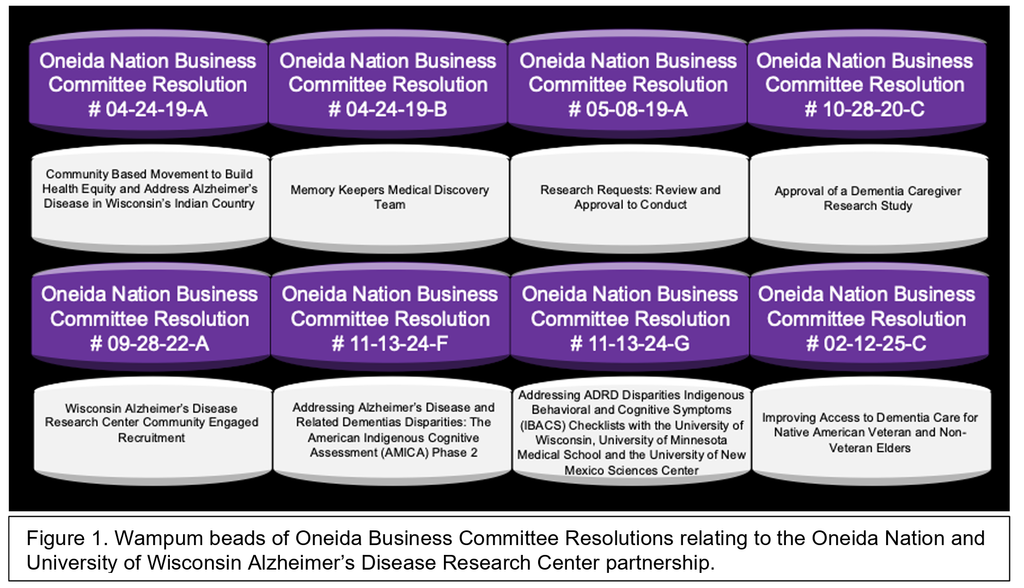
Figure 1 shows the research partnership-related resolutions made by the Oneida Business Committee, the nine-member elected body which governs the Oneida Nation when the General Tribal Council (all citizens of the Oneida Nation) is not in session. Resolutions document the official decisions made by the Oneida Business Committee, and the eight current resolutions in Figure 1 all pertain to the Oneida Nation and the University of Wisconsin-Madison ADRC research partnership. Of note, Oneida Nation Business Committee Resolution # 05-08-19-A was created due to the growth of the research partnership and encouragement by ONCOA. This resolution dictates the processes for any research to be formally approved by the Oneida Nation.12 These resolutions have cemented the sovereignty of the Tribe as the necessary basis of the research partnership.Collections
Results of the Oneida Nation and the University of Wisconsin-Madison Research Partnership
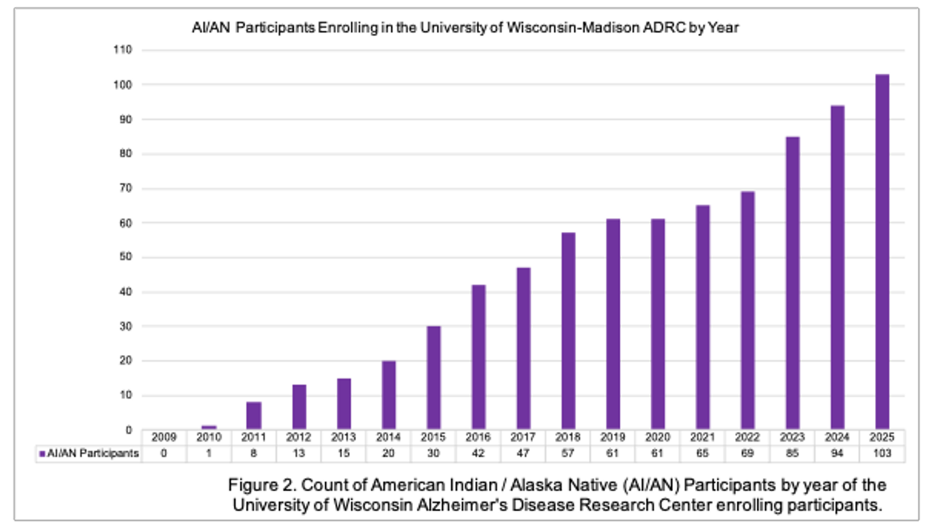
There have been many rich downstream impacts from the research partnership. The University of Wisconsin-Madison ADRC has benefitted from the increase in Indigenous participants. This is seen in Figure 2 where a steady increase in participants enrolling in the ADRC is seen following the beginning of the partnership occurring in 2015. The Indigenous participants have enrolled in the ADRC’s main studies as well as multiple lines of complementary research that partner with the ADRC.
The research produced from this partnership has also created nineteen citable articles and abstracts,13-33 and the data from the partnership has contributed to hundreds of more formal research reports. The community-based participatory research practices in this partnership are previously reported.21,22 More importantly than the funding of research with the Oneida community and the increase in publications from this research, Oneida has received secondary benefits including increases in ADRD education, awareness, destigmatization, workforce development, and data governance.
Education at outreach events and through written communications has increased the community’s knowledge of ADRD. Events such as the GLNAEA dementia educational sessions, the OCHD Quarterly Community Meetings, the ONCOA and Oneida Aging & Disability Services’ Annual Elder Expo, and other outreach events have provided opportunities for Oneida Elders, their caregivers, and the community to have informational discussions on memory changes and ADRD. Communications such as the Oneida Kalihwisaks and social media accounts on Facebook have provided information on the research partnership and ADRD for the community.
Overall awareness of the Nation regarding ADRD has increased through the research partnership through the Nations processes and presence of the research team in community. Going through the OCHD and Oneida Business Committee processes for research approval, as seen in Figure 1, have increased the Nation’s awareness of ADRD and current resources available at the state, local, and federal levels to complement resources present within Oneida. The presence of research staff from Oneida who live and work in Oneida has also increased accessibility of ADRD knowledge to the community. In addition to the tens of workforce positions the research partnership has created in the Oneida community, there have also been dozens of education and training opportunities. Due to the guidance of the University of Wisconsin-Madison NACHP, Indigenous students and professional trainees at all educational levels have been involved in the research partnership. The research experiences supported by NACHP enhanced the community’s workforce to conduct ADRD research and address the community’s specific needs.
However, there is stigma around ADRD in Indigenous communities,34 which negatively affects those living with ADRD and their caregivers. As more Oneida community members have participated in the research, heard of the research, and/or attended educational sessions on ADRD, the stigma associated with ADRD in the community has lessened. Destigmatization of ADRD has increased community desire to age healthily in place. Before the partnership and subsequent educational events on ADRD, most Elders would not mention the words “Alzheimer’s disease.”
An additional benefit of the research partnership has been the Tribe’s written ownership of the research data. The Oneida Business Committee, through recommendations from the OCHD Division Director’s review of proposed research, has ensured Oneida retains ownership of all research data. The community-based participatory research practices of the research partners enabled Tribal officials to specify this data governance through organic conversations. The Oneida Business Committee resolutions (Figure 1) authorizing research in the partnership has included clauses specifying “that any data collected will remain the property of the Oneida Nation.” Retention of the ownership of data systematically throughout the research process has ensured Oneida directs the sharing of the research data and how anyone subsequently interacts with and reports on Oneida’s data.35
Future Priorities of the Oneida Nation and the University of Wisconsin-Madison Research Partnership
While much has been accomplished in the past decade of the research between the Oneida Nation and the University of Wisconsin-Madison ADRC, there remain many gaps of needs met for Indigenous Elders and opportunities to advance ADRD prevention and treatment strategies. To prioritize and meet the needs of Indigenous Elders, a next step of this research partnership is to expand collaborations with the University of Wisconsin-Madison ADRC with other Tribal Nations in the local region. It has been a goal of the CAB to improve access to culturally tailored ADRD diagnostics and memory care for all Indigenous Elders, and the research team is engaging other Tribal Nations with the assistance of the University of Wisconsin-Madison NACHP and GLNAEA. As a part of reaching all Indigenous Elders, the CAB is also focused on engaging military veterans and Indigenous youth in the research partnership and identifying support mechanisms for these specific subpopulations living with or caring for ADRD.
Moving forward, the research partnership is prioritizing all research funding going directly to the Tribe to ensure Aging & Disability Services and ADRD education, awareness, and de-stigmatization are supported, and research opportunities are integrated. Future discussions on data security, data storage, and Oneida specific data being accessible are areas for further development. Future research opportunities include advancing biomarker analyses to be equitable measures for Tribal members, improving diagnostic services, and incorporating the AMICA and other research findings into primary care practice. The research partnership also aims to create paths for increased education on legal paperwork and post-mortem necessities of the community.
The research partnership between the Oneida Nation and the University of Wisconsin-Madison ADRC has illustrated many key mechanisms applicable to academic and Tribal Nation research partnerships. Most importantly, research teams partnering with Indigenous communities must recognize Tribal sovereignty of data and research and partner with local government(s) to ensure data rights and governance mechanisms are compliant with Tribal Nation laws and customs. As research dedicated to the needs of Indigenous Elders is scientifically justified, researchers in partnership with Tribal Nations must communicate the scientific justifications for Indigenous-specific research to funding agencies and throughout their academic institutions.
Key practices include transparency in decision-making, valuing the partnership over other pressing priorities, and implementing research activities through thoughtful and deliberate ways that center Indigenous voices. Throughout this research partnership, Indigenous Elders and their community have been partners in academic research to understand and prevent ADRD. Future collaborations started by Tribal leaders will advance treatment, diagnostic, and preventative measures for Indigenous Elders and their communities.
Funding and Acknowledgements:
The authorship team humbly thank the Oneida Nation, the Oneida Nation Committee on Aging, the Oneida Comprehensive Health Division, the Oneida Business Committee, the University of Wisconsin Alzheimer’s Disease Research Center (ADRC), the ADRC’s Native American Outreach Team, the University of Wisconsin Native American Center for Health Professions, the Oneida Nation Veteran Services Department, the Great Lakes Native American Elders Association, the Oneida Aging and Disability Resource Center, collaborators at the Memory Keepers–Medical Discovery Team at the University of Minnesota School of Medicine, Duluth, collaborators at the University of New Mexico, and all participants of the ADRC. This work was supported by National Institutes of Health funding (R01 AG054059, P30 AG062715, P50 AG033514, R01 AG062307, R01 AG074231, R03 AG063303, UL1 TR002373), funding from the U.S. Department of Veterans Affairs (010217), funding from the U.S. Health Resources and Services Administration (AWD00002942), and in-kind support from multiple entities. This work was supported by Tribal employees, Tribal elected officials, and Tribal citizens who went above and beyond their positions to contribute to science. Any opinions, findings, and conclusions or recommendations expressed in this material are those of the author(s) and do not necessarily reflect the views of the funders, the Oneida Nation, or the authors’ affiliations.
References:
- E. R. Mayeda, M. M. Glymour, C. P. Quesenberry, R. A. Whitmer, Inequalities in dementia incidence between six racial and ethnic groups over 14 years. Alzheimer’s & Dementia 12, 216–224 (2016).
- H. Y. Chen, P. K. Panegyres, The Role of Ethnicity in Alzheimer’s Disease: Findings From The CPATH Online Data Repository. Journal of Alzheimer’s Disease 51, 515–523 (2016).
- Oneida Nation, Tribal Membership 2025. Oneida Nation, 1–40 (2025). Retrieved from https://oneida-nsn.gov/wp-content/uploads/2025/07/2025-Semi-Annual-Oneida-Nation-Enrollment-Statistics.pdf
- Oneida Nation, Oneida Nation 2022 Community Health Assessment. Oneida Nation, 1–39 (2022). Retrieved from https://oneida-nsn.gov/wp-content/uploads/2023/04/Published-Booklet-2022-CHA-MP-2.13.23.pdf
- Oneida Nation, ONCOA: Oneida Nation Commission on Aging. Oneida Nation, 1–2 (2016). Retrieved from https://oneida-nsn.gov/wp-content/uploads/2016/06/ONCOA-brochure.pdf
- Oneida Nation, Oneida Aging and Disability Services (webpage). Oneida Nation (2026). Retrieved from https://oneida-nsn.gov/divisions/human-services/agingdisabilityservices/
- University of Wisconsin Alzheimer’s Disease Research Center, Raising awareness of Alzheimer’s disease in Wisconsin’s Indian Country (webpage). University of Wisconsin (2026). Retrieved from https://www.adrc.wisc.edu/oneida
- F. Petri, J. Breuninger, T. Hetzel, N. Lambrou, The Story of the Oneida Nation Alzheimer’s Community Advisory Board: Improving Dementia Outcomes Through Community-Based Collaborations. Alzheimer’s Association Wisconsin State Conference (2025). Retrieved from https://www.alz.org/getmedia/bdd24aa0-4e49-469c-9a5f-2f1f5f2c9f1f/204-the-story-of-the-oneida-nation-alzheimer-s-community-advisory-board-improving-dementia-outcomes-through-community-based-collaborations.pdf
- Oneida Nation, Oneida Nation Alzheimer’s Community Advisory Board: C.A.B. Oneida Nation, 1–2 (2024). Retrieved from https://oneida-nsn.gov/wp-content/uploads/2024/06/ICARBrochure.pdf
- F. Ettawageshik, E. S. Norman, From ‘Stakeholder to rights-holder’: Re-examining the role of Indigenous Peoples in the International Joint Commission as the third sovereign. The First Century of the International Joint Commission, 433-456 (2020).
- Oneida Nation, Oneida Nation Dementia Care Specialist. Oneida Nation, 1–2 (2016). Retrieved from https://oneida-nsn.gov/wp-content/uploads/2016/06/DCS-brochure-8-2015.pdf
- Oneida Nation, BC Resolution # 05-08-19-A Research Requests: Review and Approval to Conduct. Oneida Nation, 1–3 (2019). Retrieved from https://oneida-nsn.gov/wp-content/uploads/2019/05/05-08-19-A-Research-Requests-Review-and-Approval-to-Conduct.pdf
- C. Trojanczyk, M. Zuelsdorff, M. Summers, L. Strong, P. Lassila, W. Martin, H. Salazar, N. H. Lambrou, D. W. Skenandore Jr, F. P. Carter, N. A. Chin, P4‐623: LESSONS FROM A RESEARCH COLLABORATION WITH THE ONEIDA NATION OF WISCONSIN. Alzheimer’s & Dementia, 15, P1565–P1566 (2019).
- C. E. Gleason, W. Martin, L. Strong, M. Summers, N. H. Lambrou, M. Zuelsdorff, N. A. Chin, J. Krainer, P. Lassila, D. A. Miller, K. Jacklin, F4‐06‐02: IMPROVING DEMENTIA OUTCOMES IN INDIAN COUNTRY: THE ONEIDA NATION ALZHEIMER’S DISEASE PROJECT. Alzheimer’s & Dementia, 15, P1227–P1227 (2019).
- H. Ford, Why are we doing this? (1995).
- N. H. Lambrou, M. F. Wyman, D. A. Miller, L. Thomas, L. Strong, M. Summers, P. Lassila, F. Petri, D. Miller, S. Wheelock, B. Williams, Perspectives on dementia and family caregiving among the Oneida Nation of Wisconsin: Dementia care research (research projects; nonpharmacological)/Community care. Alzheimer’s & Dementia, 16, e040652 (2020).
- M. Wyman, N. Lambrou, D. Miller, S. Wheelock, F. Petri, M. Summers, C. Gleason, D. Edwards, Perspectives on Dementia Service Use and Family Caregiving Among the Oneida Nation of Wisconsin. Innovation in Aging, 4(Supplement_1), 710–710 (2020).
- M. Wyman, D. Miller, S. Wheelock, F. Petri, E. Metoxen, N. Lambrou, C. Gleason, Utilization of Home and Community-Based Resources by Family Caregivers in a Native American Community. Innovation in Aging, 5(Suppl 1), 352 (2021).
- M. F. Wyman, C. A. Van Hulle, E. Umucu, S. Livingston, N. H. Lambrou, F. P. Carter, S. C. Johnson, S. Asthana, C. E. Gleason, M. Zuelsdorff, Psychological well-being and cognitive aging in Black, Native American, and White Alzheimer’s Disease Research Center participants. Frontiers in human neuroscience, 16, 924845 (2022).
- M. F. Wyman, N. H. Lambrou, J. P. Lewis, H. M. Buerger‐Cole, C. Hammock, K. Klammer, S. L. Lawrence, D. A. Miller, F. Petri, J. D. Perzynski, A. L. Johnson, Family Caregiving in a Great Lakes Native American Community: A Mixed Methods Study of Service Utilization. Alzheimer’s & Dementia, 19, e073369 (2023).
- M. Blind, K. Jacklin, K. Pitawanakwat, D. Ketcher, N. Lambrou, W. Warry, Training indigenous community researchers for community-based participatory ethnographic dementia research: a second-generation model. International journal of qualitative methods, 22, 16094069231202202 (2023).
- M. Wyman, H. Buerger-Cole, N. Lambrou, J. Perzynski, S. Lawrence, D. Miller, F. Petri, J. Lewis, ONEIDA HELPING ONEIDA: DECISION MAKING ABOUT SERVICE USE BY ONEIDA NATION FAMILY CAREGIVERS. Innovation in Aging, 7(Supplement_1), 246–247 (2023).
- A. L. Johnson, E. Seep, D. L. Norton, M. P. Mundt, M. F. Wyman, T. T. James, M. Zuelsdorff, N. H. Lambrou, L. W. Y. McLester-Davis, E. Umucu, C. E. Gleason, Wisconsin healthcare utilization cost among American Indians/Alaska Natives with and without Alzheimer’s disease and related dementias. Journal of Alzheimer’s Disease, 91(1), 183–189 (2023).
- L. W. Y. McLester‐Davis, C. E. Gleason, H. M. Blazel, M. Zuelsdorff, N. H. Lambrou, T. Parker, Indigenous data sovereignty in the context of big data. Alzheimer’s & Dementia, 19, e068387 (2023).
- L. W. Y. McLester-Davis, Telomere Length: A Biomarker of Aging in Neurodevelopment and Neuropyschological Performance for Minoritized Populations (Doctoral dissertation, Tulane University, (2023).
- M. Blind, S. Cavanaugh, N. Tsosie, C. Trojanczyk, N. Lambrou, C. Gleason, T. Parker, K. Jacklin, AMICA DEMENTIA SCREENING TOOLS ADAPTATION: AN INTERCULTURAL CONSENSUS APPROACH. Innovation in Aging, 8(Supplement_1), 276–276 (2024).
- T. T. James, G. Levy, O. J. Hills, T. Ellis, A. Benitiz, S. L. Lawrence, C. E. Gleason, M. Metoxen, M. C. M. Pinzon, Disseminating COVID‐19 and Alzheimer’s Disease Information to Underrepresented Communities Using Social Media. Alzheimer’s & Dementia, 19, e080392 (2023).
- K. Jacklin, M. Blind, W Warry, W., Lambrou, N., Gleason, C., Zuelsdorff, M. and Ketcher, D., 2024. INDIGENOUS EXPLANATORY MODELS OF DEMENTIA: RESULTS FROM HEALTHY OLDER ADULTS IN NORTH AMERICA. Innovation in Aging, 8(Supplement_1), 275–275 (2024).
- M. Mora Pinzon, O. Hills, G. Levy, T. T. James, A. Benitez, S. Lawrence, T. Ellis, V. Washington, L. Solorzano, P. Tellez-Giron, F. Cano Ospina, Implementation of a Social Media Strategy for Public Health Promotion in Black, American Indian or Alaska Native, and Hispanic or Latino Communities During the COVID-19 Pandemic: Cross-Sectional Study. Journal of Medical Internet Research, 26, e58581 (2024).
- Y. Ma, M. C. Mora Pinzon, W. R. Buckingham, A. J. Bersch, W. R. Powell, T. J. LeCaire, G. E. Ennis, Y. Deming, E. M. Jonaitis, N. A. Chin, L. R. Clark, Comparison of sample characteristics of Wisconsin Alzheimer’s Disease Research Center participants with the Wisconsin state population—An evaluation of the recruitment effort. Alzheimer’s & Dementia: Translational Research & Clinical Interventions, 11(1), e70036 (2025).
- N. H. Lambrou, M. J. Blind, D. Ketcher, C. Pederson, J. Johnson, A. Hill, M. Dertinger, J. Chiovitte, R. Trudeau, K. Pitawanakwat, L. Strong, Indigenous cultural understandings of Alzheimer’s disease and related dementias–research and engagement (ICARE): relationships between cultural strengths, education and stigma. Alzheimer’s & Dementia, 18, e066094 (2022).
- M. F. Wyman, D. B. Lennon, J. Montoure, L. W. Y. McLester-Davis, C. Hammock, N. Lambrou, S. Lawrence, D. A. Miller, F. Petri, M. Zuelsdorff, C. E. Gleason, Awareness of family caregiver resources and alignment with traditional culture in a Midwest Tribal Nation in the United States. Journal of Community Health, (2026).
- C. Gleason, N. Lambrou, M. Blind, D. Ketcher, E. Weigler, M. Dertinger, J. Johnson, A. Mason, S. Ninham, K. Pitwanakwat, C. Pederson, L. Metoxen Strong, M. Summers, R. Trudeau, W. Warry, K. Jacklin, Healthcare provider experiences delivering dementia care in Indigenous communities: Challenges and recommendations. The Gerontologist, (2026).
- C. Allick, Perceptions of cognitive decline among American Indian and Alaska Native elders. Alzheimer’s & Dementia: Diagnosis, Assessment, & Disease Monitoring, 16:2, e12611 (2024).
- S. R. Carroll, D. Rodriguez-Lonebear, A. Martinez, Indigenous data governance: Strategies from United States Native Nations. Data Science Journal 18:31 (2019).